Wednesday, October 04, 2006
Yes, Just Like This
This is really good. I must admit, I'm a little disappointed it's just an art project.


I'm Going to Be a Big Star Someday
From the World's Finest News Source:
Don't cry for me, though: My legacy will extend far beyond your lifetime. After my spectacular collapse due to hot-and-fast living, you'll look up, and I'll be as bright as ever. No one will even know I'm gone.
Don't cry for me, though: My legacy will extend far beyond your lifetime. After my spectacular collapse due to hot-and-fast living, you'll look up, and I'll be as bright as ever. No one will even know I'm gone.

Top Ten Reasons Religion is Like Pornography
Top Ten Reasons Religion is Like Pornography
10. It has been practiced for all of human history, in all cultures
9. It exploits perfectly natural, even commendable, impulses
8. Its virtues are debatable, its proponents fanatical
7. People love it, but can't give a rational reason for it
6. Objectifies and degrades women even when it worships them
5. You want to wash up after shaking hands with any of its leaders
4. The costumes are outrageous, the performances silly, the plots unbelievable
3. There's nothing wrong with enjoying it, but it's nothing to be proud of, either
2. It is not a sound basis for public policy, government, or international relations
1. Its stars are totally fake
Via
"Going to Be"
As if! I'm doing this now! "casue I'm the shiznitx!
(I can see my son's eyes rolling back into his head as I write this. This makes up for *so many* poopy diapers!)
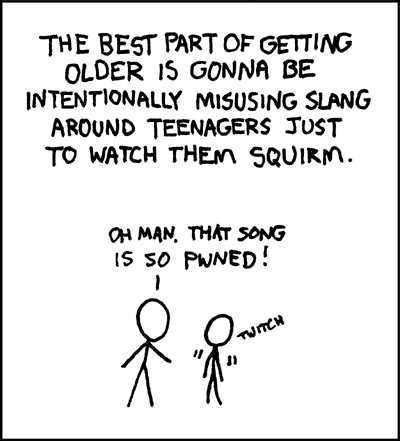
(I can see my son's eyes rolling back into his head as I write this. This makes up for *so many* poopy diapers!)
Tuesday, October 03, 2006
So Much for the Afterlife
Looks like science has finally put the last nail in the coffin of the afterlife. In the last few years a number of mystical experiences have been sufficiently explained by brain function, e.g. ghosts, night terrors, religious euphoria, feeling the divine, near death experiences etc. Each one can be duplicated now in some way. The last one was Astral Projection, leaving one's body, looking down at it and flying around. This has happened to me several times and it's really, really weird. Even cranky, skeptical me was not so sure that there wasn't *something* to it.
Now, this can be duplicated as well and, of course, it's brain function:
“The research shows that the self can be detached from the body and can live a phantom existence on its own, as in an out-of-body experience, or it can be felt outside of personal space, as in a sense of a presence,” Dr. Brugger said.
Scientists have gained new understanding of these odd bodily sensations as they have learned more about how the brain works, Dr. Blanke said. For example, researchers have discovered that some areas of the brain combine information from several senses. Vision, hearing and touch are initially processed in the primary sensory regions. But then they flow together, like tributaries into a river, to create the wholeness of a person’s perceptions. A dog is visually recognized far more quickly if it is simultaneously accompanied by the sound of its bark.
That's pretty much it. There is no afterlife, just the experiences generated by a dying brain trying to keep itself alive.
I can't say this is an inspiring discovery, but it is a comfort to know we live in world of our own design.
Friday, September 29, 2006
Been A While
Sorry all, this has been a busy week at work. Hopefully things will calm down a little next week and I can get back to being amusing and leveling my Blaster.
Passing this along as it's been awhile since I mocked the religious. It has an interesting origin here. Hank (not the story protagonist) is one of the folks I see in City of Heroes on a regular basis.
Passing this along as it's been awhile since I mocked the religious. It has an interesting origin here. Hank (not the story protagonist) is one of the folks I see in City of Heroes on a regular basis.
Friday, September 22, 2006
Economics and Rational Decisions
It turns out that emotion really is a key factor, equal to or sometimes greater than reason.
This is a very interesting article in which a team did brain scans of people making economic decisions to see how their minds work.
Cohen and several colleagues organized a series of ultimatum games in which half the players—the respondents—were put in MRI machines. At the beginning of a round, each respondent was shown a photograph of another player, who would make the respondent an offer. The offer then appeared on a screen inside the MRI machine, and the respondent had twelve seconds in which to accept or reject it. The results were the same as in other, similar experiments—low offers were usually vetoed—but the respondents’ brain scans were revealing.
When respondents received stingy offers—two dollars for them, say, and eight dollars for the other player—they exhibited substantially more activity in the dorsolateral prefrontal cortex, an area associated with reasoning, and in the bilateral anterior insula, part of the limbic region that is active when people are angry or in distress. The more activity there was in the limbic structure, the more likely the person was to reject the offer. To the researchers, it looked as though the two regions of the brain might be competing to decide what to do, with the prefrontal cortex wanting to accept the offer and the insula wanting to reject it. “These findings suggest that when participants reject an unfair offer, it is not the result of a deliberative thought process,” Cohen wrote in a recent article. “Rather, it appears to be the product of a strong (seemingly negative) emotional response.”
This doesn't bode well for the communist/libertarian utopias that are sure to come this century. If people don't make rational decisions, it implies that markets are not all that rational either (housing bubble anyone?) and may not always produce the best result.
Unfortunately, while interesting, the results point more toward what *doesn't* work than to what will.
Wednesday, September 20, 2006
Yellow Book, not that Other Book
Cool! Springer, makers of the famous series of yellow mathematics books, is offering free access to their archives, going back to 1869.
If you're as thrilled about this as I am, you... *really* need to get a life!
If you're as thrilled about this as I am, you... *really* need to get a life!
How to Hack the Diebold Voting Machine: the Video
Complete instructions on how to make a Diebold Voting machine throw votes anyway you want regardless of what the users actually put in.
it's a little slow getting started but worth the time.
Also note, as reported in other venues, the standard administrator password is 2 letters. The flaws in this machine have been known in the crypto community since 2002. To date, Diebold has fixed exactly zero of them.
On a personal level, I know some of the folks at Diebold. They are *very* hesitant to talk about this at all, however the one time we had a serious security discussion one of the guys floored me with this line:
"The real problem is that the machine votes are *too accurate*. It embarasses a lot of customers when their districts come out as being strongly in the other party, so they call and complain"
Weird
Tuesday, September 19, 2006
Monday, September 18, 2006
Sunday, September 17, 2006
Friday, September 15, 2006
"Claptrap"
Greg Easterbrook reviews Lee Smolin's book on what's wrong with String Theory.
The Upfront:
Lee Smolin is a brilliant theoretical physicist who has worked for many years in the bowels of string theory. His book and Peter Woit's Not Even Wrong are interesting and important, and the point they make is quite possibly correct.
I've read a lot on strings, worked through the math at about a graduate (but not professional) level, understand the main concepts, (at least from the period between the 1920's and the early 1990's) and have tried to form an intelligent, well reasoned opinion on it. I've kind of failed in this. There is a point in string theory past which it is simply black to me. If someone like Smolin, Hawking or Page sketches out a proof for me in some of the really abstract stuff, I might get a glimmer of how this fits in, but I'm incapable of doing this on my own from scratch.
The parts of string theory I understand make sense. I can easily show a unification of gravity and EM in a few as 5-dimensions (hint: Einstein and Kaluza did this in the '30s. It's not rocket science by today's standards). I have no clue if it's right, but I do understand that we're missing something fundamental in physics, much like we missed photon quantization in the 19th century.
The Gripe:
This review is awful.
C'mon who uses the "claptrap"? String theory may be off the rails, it may be overly complex, it might even be wrong, but it's not useless claptrap. It's a fairly useful theoretical framework for understanding the otherwise totally inexplicable.
Then there is this interesting paragraph:
And consider this. Today if a professor at Princeton claims there are 11 unobservable dimensions about which he can speak with great confidence despite an utter lack of supporting evidence, that professor is praised for incredible sophistication. If another person in the same place asserted there exists one unobservable dimension, the plane of the spirit, he would be hooted down as a superstitious crank.
There is so much wrong with this collection of words, so many confabulations of things which don't go together, so many little straw men standing in a wheat field, I don't even know where to begin. He's brought together religion, science, some math he clearly doesn't understand and (seemingly) a general grudge against science into a one entangled knot of ego-satisfying word-salad. How can an editor let this through?
Then there is a whole 'graph on the word "theory" and for the second time a comparison to Darwin and creationists:
Really, string theory isn't a theory at all. Creationists who oppose the teaching of Darwin have taken to deriding natural selection as "just a theory," and Darwin's defenders have rightly replied that in science, "theory" does not mean idle speculation. Rather, it is an honored term for an idea that has been elaborately analyzed, has not been falsified, and has made testable predictions that have later proven to be true. The ordering of scientific notions is: conjecture, hypothesis, theory. Pope John Paul II chose his words carefully when in 1996 he called evolution "more than a hypothesis." Yet the very sorts of elite-institution academics who snigger at creationists for revealing their ignorance of scientific terminology by calling evolution "just a theory" nonetheless uniformly say "string theory." Since what they're talking about is strictly a thought experiment (just try proving there are no other dimensions), from now on, "string conjecture," please.
String Theory is a theory. some of it's aspects are testable, but not yet tested. It's not that people don't want to test them, or are arguing that they shouldn't be tested. I freely grant that the whole of the theory is not testable or for that matter expressible as a simple set of axioms accessible to the general public). It's disingenuous for Easterbrook to suggest that they are unprovable.
Ugh. String theory can be criticized on a lot of points and may quite well be wrong, however Easterbrook doesn't use any of them instead settling for some gratuitous science bashing and equating science and religion.
His review is a piece of shit.
Aspartame
Wow.
So, a concerned and intelligent friend of mine send me an article on the side effects of Aspartame, which include a host of fuzzy neurological symptoms, many of which I sometimes seem to display. I read the article, decided I didn't really know much about the chemical other than the fact that it pops up from time to time as having caused "health problems"
Turns out, the note she sent me was already listed as an Urban Legend.
Okay, not a promising start, but also not really evidence either way.
Turns out it's surprisingly hard to get a decent review of Aspartame that isn't sponsored by someone with a clear interest in it being safe/unsafe. Even the wiki entry is surprisingly unscientific claiming:
"Some point to the rapid breakdown of aspartame causing spikes of phenylalanine and aspartic acid which can upset chemical balances and cross the blood-brain barrier, as well as unnatural spikes in levels of methanol in places the body does not normally encounter it (like within metabolic processes), raising concerns as to its safe containment and elimination."
There are victim groups, lawsuit groups, consipracy groups etc. etc. Jesus Christ folks! It's not like the want to put floride in your water!
After digging through a couple of dozen sites, I finally found a decent one with some science in it.
Bottom line: You're at more risk from fruit juice than aspartame.
Ripped From the Headlines: Woman pleads guilty in fake penis case
Here
MCKEESPORT, Pa. --A woman pleaded guilty to disorderly conduct in connection with a bizarre incident in February that resulted in a fake penis being microwaved at a convenience store.
Leslye Creighton, 41, of Wilkinsburg, entered the plea Wednesday, and authorities dropped the same charge against Vincent Bostic, 31, of Pittsburgh, who has agreed to help pay $425 to replace the store's microwave, police and the couple's defense attorney said.
Police in McKeesport, about 10 miles east of Pittsburgh, said the Feb. 23 incident began when Bostic filled a fake penis with his urine that they said Creighton planned to use to pass a drug test to get a job.
The two stopped at a GetGo! convenience store and, after wrapping the device in a paper towel, asked a store clerk to heat it up in a microwave, police said. Authorities said they believe Creighton wanted the device heated so the urine inside would be at body temperature during the drug test.
The clerk, however, believing the lifelike device to be a severed penis, called police.
Defense attorney William Difenderfer said Creighton faces a maximum punishment of $300 and 90 days in jail when she is sentenced Nov. 15 by McKeesport District Judge Doug Reed. Difenderfer called it "a humorous, but weird, case."
Embarassing Disclaimer: I went to high school not far from there.
Tuesday, September 12, 2006
Things We Want to Become True
An interesting debate between Mitchell Kapor and Ray Kurzweil on whether or not the statement "By 2029 no computer - or "machine intelligence" - will have passed the Turing Test. " is true. Obviously I am on Kapor's side, althought I admit a) I'd like to lose and b) it's at least theoretically possible I will.
What I think is interesting is their styles of arguement. Ray is arguing like a SciFi fan, glossing over the hard truths to get to the visionary statement, then turning around and saying that, becuase the vision is so compelling, it *must* be true. Kapor is arguing more about the science involved, and one statement in particular has been key in my own arguments:
Additionally, part of the burden of proof for supporters of intelligent machines is to develop an adequate account of how a computer would acquire the knowledge it would be required to have to pass the test. Ray Kurzweil's approach relies on an automated process of knowledge acquisition via input of scanned books and other printed matter. However, I assert that the fundamental mode of learning of human beings is experiential. Book learning is a layer on top of that. Most knowledge, especially that having to do with physical, perceptual, and emotional experience is not explicit, never written down. It is tacit. We cannot say all we know in words or how we know it. But if human knowledge, especially knowledge about human experience, is largely tacit, i.e., never directly and explicitly expressed, it will not be found in books, and the Kurzweil approach to knowledge acquisition will fail.
In one of his books, Charlies Stross has the ship AI of a starship crossing space reach a critical point and transcend. It figures out enough physics to build an instantaneous network and cuts it's journey short. This has always struck me as the fundemental problem with how AI is protrayed and seems to be the strength of Ray's arguement. It will just happen. OTOH, those of us who have done scientific research know it's a messy business. Lots of mistakes, lots of errors and, most importantly, lots and lots of experiments. This is what Kapor is arguing, and it seems far more grounded in reality.
Will we have computers as fast or faster than the human brain by 2029? Possibly. Will they have human intellect? Well, it takes a human brain, interacting with the world many years to get to concrete operational thinking (indeed, many never do. There is much less difference between your brain and a person with an IQ of 50 than there is between your brain and chimps). It seems very unlikely that we'll have the ablity to do the soft skills, the reasoning by that point.
Much as I want it to be true, I have to put my money with Kapor.
Subscribe to:
Posts (Atom)